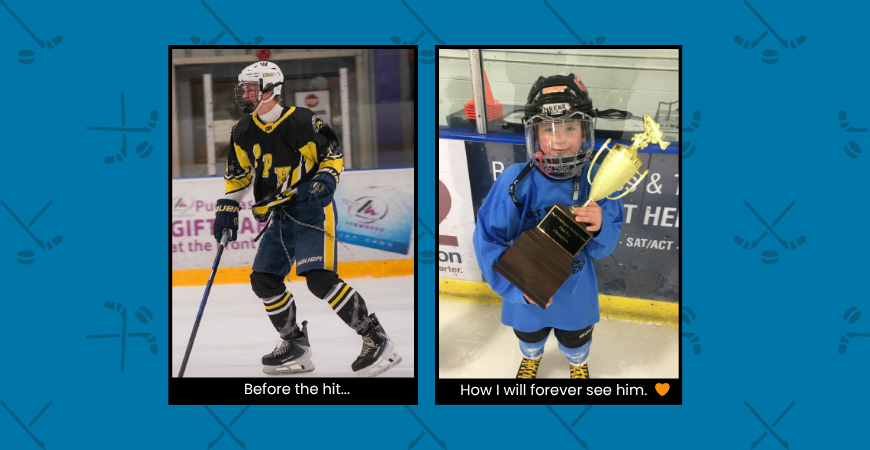
Anyone who knows me knows we are a hockey family. I have three boys and they all play travel hockey. This past weekend, all three boys had tournaments in three different states so this was the first time that my husband or I couldn’t be at all of the games. My middle son went to his tournament with a good friend and his mother. I was in Connecticut with my youngest but watched almost every minute of both my older sons’ games on various paid streaming services like LiveBarn.
I was watching my middle son’s game and saw him with the puck in the corner, his opponent checked him into the boards – his shoulder hit my son’s head, his head went into the boards, then his body fell down to the ice. For 12 excruciating seconds he didn’t move. For another minute and nine seconds he just laid there on the ice.
Livebarn doesn’t have game announcers, but you can hear things. For that 91 seconds there was nothing but deafening silence. My chest got tight, my ears started to ring – I saw his teammates go to him, the coach shuffled across the ice and got on bended knee to talk to him. He slowly got up, steadied himself and gingerly skated off the ice. I realized I was holding my breath and finally exhaled.
Why it’s important to proceed with caution.
With three boys that love sports and to tackle each other, we’ve been down this road before and I’ve learned a thing or two with every trip to the ER and neurologist.
Concussions aren’t always so easy to diagnose so it’s very important to proceed with caution. According to the Cleveland Clinic, a concussion is a mild traumatic brain injury caused by a bump, blow or jolt to the head or body that causes the brain to shake, disrupting normal function. It’s not always a dramatic check into the boards and loss of consciousness doesn’t always occur. It can happen at home when they’re just playing and bump their heads.
The symptoms also don’t always appear immediately and can be a whole range of things. Some key indicators to be on the lookout for:
- Headache
- Nausea / vomiting
- Light sensitivity
- Non-reactive pupils
- Moodiness / mood swings
- Dizziness / balance issues
- Different sleep patterns (more or less)
- Blurry vision
-
Brain fog
Nobody wants to admit that they may have a concussion. At the very basic level, it prevents you from playing the game you love. But on a mental/emotional level, boys and men often push through due to a fear of losing playing time, being perceived as not being there for the team, even being seen as “weak.” The concussion itself can sometimes impair judgement – that, and the “tough guy” culture can lead to much more devastating events.
My son – after the hit, after 91 seconds down on the ice – went back and skated the rest of the game. I was paralyzed with fear watching helplessly 200 miles away. Because I knew that a second hit to the head, within 24 hours, could be so much more devastating.
According to the National Institute of Health, two traumatic brain injuries within 24 hours can cause Second Impact Syndrome (SIS) a rare but devastating condition where the brain loses the ability to autoregulate which can lead to rapid and catastrophic swelling, severe disability, even death within minutes. The brain is extremely vulnerable during the first 24 hours and a second hit – even a minor one – before the first injury has time to heal – can cause immediate and irreversible harm.
Youth - The Age of Invincibility
I remember being his age and thinking I was invincible – so I knew he thought the same. When my son called me from the locker room, his voice was strong and confident, but I still didn’t want him going back out on the ice. As luck would have it, the team missed advancing in the tournament by one point which meant, much to my relief, they would be coming home.
He looked good, but mentioned his head hurt (“just a little, very minorly”) and his stomach felt off – but he was confident he didn’t have a concussion. To be on the safe side, I made an appointment with our doctor and encouraged him to be honest with the doctor.
I learned a few years ago from a neurologist at Hospital for Special Surgery in New York, that the medical profession has moved away from grading the severity of a concussion – there’s not a mild, medium and/or severe concussion. A concussion is a concussion and you treat the symptoms for as long as they last.
The doctor confirmed my suspicion and diagnosed my son with a concussion and prescribed no contact sports for 7 days (minimum), no screens for 3 days with a gradual reintroduction if symptoms — i.e., light sensitivity, eye-strain — are not present.
Thankfully my son is pretty reasonable and compliant – it’s not a huge struggle (for me) to have him to reduce or eliminate screen time… but for some kids it is.
Concussions are an invisible injury that can lead to isolation.
“Concussion protocol” can often be construed as punishment because it impacts his social connection (can we say SnapChat?) and their autonomy. It’s one thing to have a broken bone – something that peers can see and draw sympathy – it’s another thing, and a frustrating one at that, to have an injury that no one can see that peers may question with an ambiguous timeline.
And yet, life doesn't pause for any of this. As a mom, you can't always be in the room. You can't always be in the same state (or country!). Sometimes you're hundreds of miles away, holding your breath and counting seconds. What you can do is prepare them — and yourself.
Talk to your kids about concussions before they happen.
Make it normal. Make it something they can say out loud without feeling like they're letting the team down. The "tough through it" culture is real, and it's not going away — but a kid who knows the stakes is more likely to speak up.
And if you're in the thick of it right now — if you're the mom managing the screen limits, the sighing and the kid who insists he's fine — you're not alone. We’re here and we hear you.
My son is doing well. He's following protocol (mostly). And I'm doing what moms do: watching, waiting, and keeping things as normal as possible until he's back on the ice where he belongs. We will go back to the doctor in a week to hopefully get him cleared to go back on the ice… I’ll keep you posted!
At 31st State, we make products for the next generation of guys — the ones who play hard, push through, and sometimes need us to pump the brakes. Keep the routine simple during recovery. We've got that part covered.